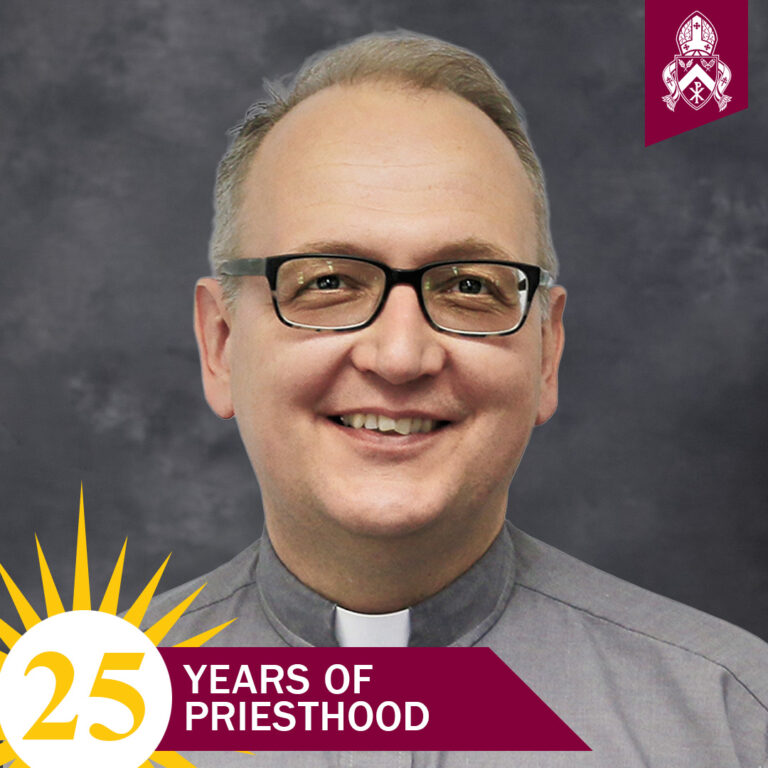
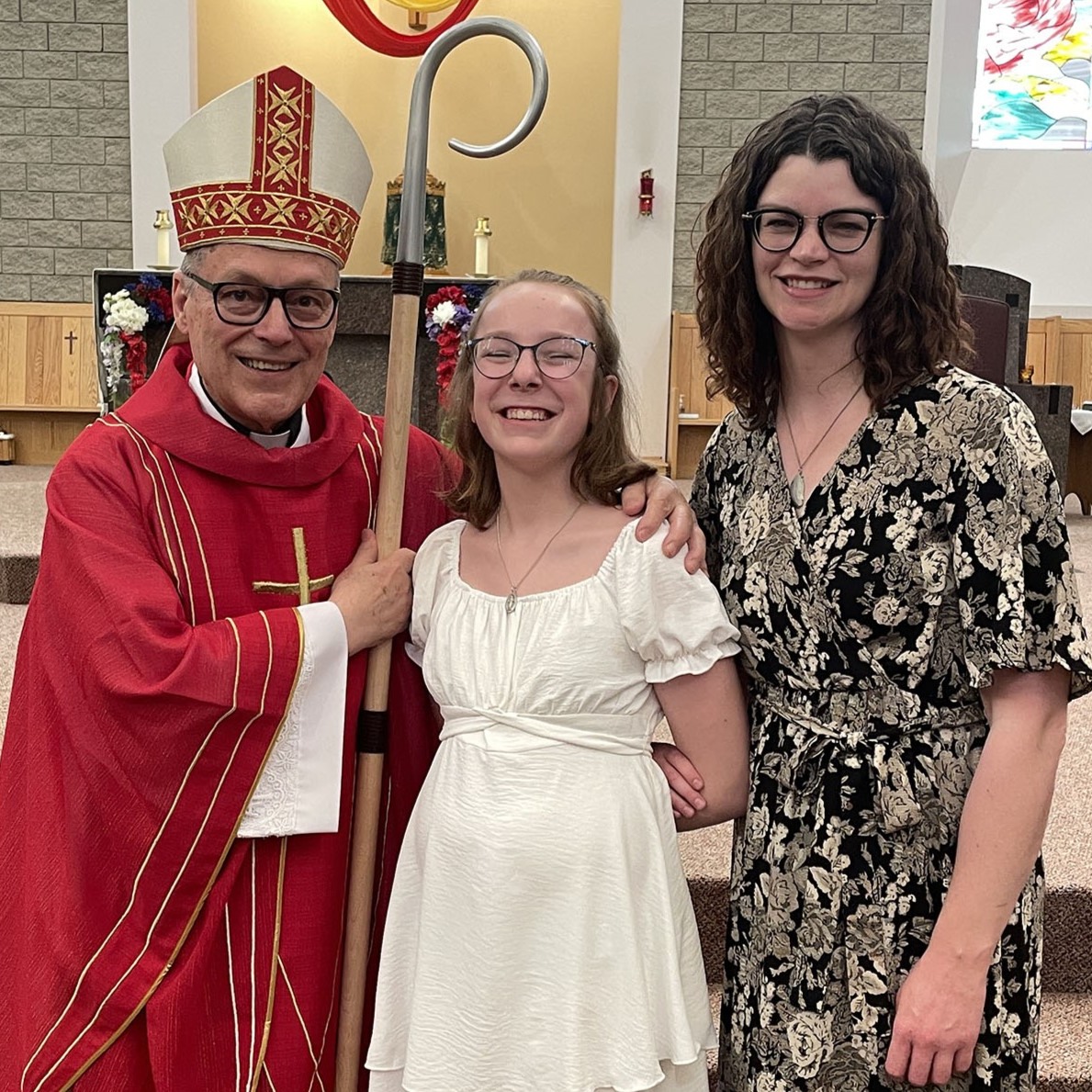
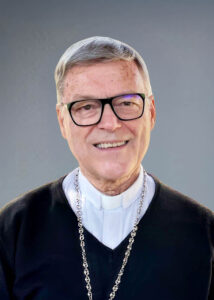
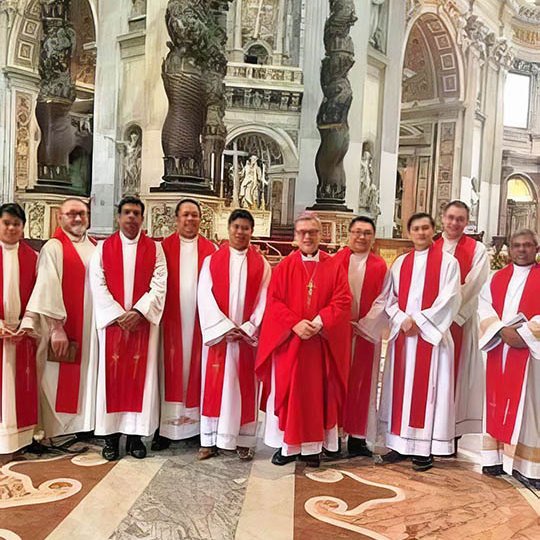
Bishop Emeritus Pau Terrio reflects on ministry, the priesthood and Catholic life as St. Joseph Seminary approaches its centennial in 2027. Bishop Terrio, ordained May 23, 1970 for the Archdiocese of Montréal, joined St. Joseph’s Seminary as a formator in 1994, was incardinated into the Archdiocese of Edmonton in 2001, and has been present to the seminary community in various capacities ever since. He agreed to an interview with seminarian David Cholewa.
Q: Given your varied experience as a formator and priest in Quebec, Brazil, and Western Canada, what makes St. Joseph’s Seminary distinct, particularly in your time as a formator? What unique opportunities or strengths were present here, that were not elsewhere?
 A: In 1994, culturally, it was a different time. There were fewer seminarians. When I arrived, I think it was up to about 22 or 23. Today, it’s more or less 40. I would say that a constant in all of the experiences that I’ve had, either being formed or being part of the formation teams, has been the sincere effort on the part of the formators to help us as future priests to establish a personal relationship with the Good Shepherd, with our Lord. That’s been a constant. Now, the social context and the issues and the communities around us have, of course varied, but that has been a common thread through the whole fabric. And that’s wonderful. That’s the ideal.
Q: You mentioned it was a different culture back then. In your time here in Western Canada, you’ve been privy to experiencing this at the highest level as a bishop. What influences do you think have affected that cultural shift? Consider this through the lens of preparing a priest for entering that particular pastoral scene.
A: When I entered the seminary for the Archdiocese of Montréal in 1966, Quebec was on the eve of major social and cultural changes. But at that time, people were still basically a very practicing population in Quebec. The full secularization was just beginning. Most people did not realize the extent to which the secularization would take over. And so, the social context, and your expectations of what you would be doing in a parish typically as an ordained priest were dated from a time when the relevance of Jesus Christ, the risen Lord, in day to day life was taken for granted.
That all changed so quickly. Coming to St. Joseph’s Seminary in Edmonton in 1994, seminarians were exceptions: they were very much a minority in society. Many of them were older, and it was sort of a second career option in the case of some of them. They were already in the secular society where an option of giving your life to priesthood was strange.
I would say that the difference now is we have a lot of young men from a homeschooling background. That is a fact. And so that means that they’re from families and family networks, which have already become accustomed to and take into account the fact that the society at large is post-Christian, and therefore, we have organized, and our identity takes that into account. We have these young men who with their presence, their devotions, and their commitment, of course, have an influence on the seminary community.
 Q: We are recording this interview on the memorial of Saint John Paul II , the Great (October 20). In 1992, he issued the apostolic exhortation Pastores Dabo Vobis, which today greatly informs the way that we approach the formation of priests here at St. Joseph’s, but more broadly across the world. I n your time as a formator, both before and after document, how did it change the way you viewed or approached formation, and what fruits have you seen from it in the time since?
A: I think Pope Saint John Paul II’s intuition, great figure and prophet that he was, was that the church has to prepare the priestly formation for the secularization of the world that we’re now witnessing and experiencing. It’s a classic formation. There’s continuity, of course. He’s taking what had been, and he’s trying to adjust it and adapt it for what is coming.
One of the more interesting things in it is that, again, from a spiritual formation perspective, is that a priest can and should grow in holiness from the very exercise of his ministry. It makes explicit and insists on the matter that formation is initial, yes, but it is ongoing. It never stops.
There’s ongoing conversion, which should be an expression of the ongoing personal communication and communion with the Good Shepherd himself. I like to use the expression, the Good Shepherd, precisely because of Pastores Dabo Vobis. He is the Good Shepherd. And in a society which has become increasingly individualistic, the Good Shepherd is the answer to those longings and what’s lacking in individuals’ lives. He is the Good Shepherd they need.
Q: Reflecting on St. Joseph’s Seminary now nearing its centennial, what are you grateful to God for, regarding St. Joseph’s and its history? What is your hope and prayer for the next hundred years of formation here in Western Canada?
A: Well, this will be informed from my experiences as a bishop in Alberta and the things that you see from that perspective. The Catholic Church generally in Western Canada has not been in a position of being the majority religious group. But there are benefits to being a minority. It does tend to firm up one’s identity, one’s understanding of oneself religiously with regard to the majority around you.
The big challenge that all seminaries and all houses of formation in North America and Western Europe and the more prosperous parts of the world face is the practical atheism of the society around us.
If you’re going be a priest, well, the people that you’re going minister to, they’re dealing with that. Not just at school, but whether at work or at leisure. We have young couples who are starting a family, but the people around them don’t understand that they want to have the children that God will give them, and that they’re open to parenting. And so, they’re the exception, even within their extended families.
The priests who are going to minister to them have to be cognizant and ready to minister in this context. I think the seminary of St. Joseph’s in Edmonton is very, very well prepared to prepare priests to minister in this society.
Q: In 2025, you marked 55 years as a priest. A great milestone, and nearing thirteen years as a bishop. In your position as a spiritual father, what is your advice for present and prospective seminarians who will soon take the torch from you in the service of God and his people?
A: It’s not for nothing that I wanted to be photographed in front of the cross, the crucifix. To discover the beauty and the strength in the cross. The problem with our society, of course, is a loss of the meaning of suffering and the cross in our lives. And this loss is the source of many problems in today’s society. Euthanasia, artificial birth control. It’s all about convenience, comfort. As a society, we are also so illiterate in terms of Scripture.
Future priests can’t take anything for granted. Basic biblical spirituality, Christocentric biblical Christianity is the way forward. And, of course, there is no Christ without the Cross and the Passion and the Crucifix, which, of course, is at the same time the Resurrection and the glory of His victory and His sacramental presence among us. There is no Eucharist without the Paschal mystery. And it only makes sense if we’re biblically literate. You have to know the Scriptures. You have to know how all its books converge in Christ, how Christ is anticipated and illuminates them all from the interior. That has to be a part of your day to day conversation with him.
Support the Foundation for St. Joseph Seminary and Newman Theological College
Sign up for The WINDOW, the weekly electronic bulletin with news from the Archdiocese of Edmonton.
David Cholewa is a seminarian for the Archdiocese of Edmonton. This article was first published in the fall 2025 edition of the Exiit Qui Seminat, the St. Joseph Seminary newsletter