When we baptize an infant, the priest normally meets the parents and godparents at the door of the church and asks the little one’s name. The implication is that the child is still a stranger and not yet a member of Christ’s Body the Church. Christ’s people don’t know this new person whose parents are asking for baptism. The priest then invites the parents and godparents to trace the sign of the cross on the forehead of the child to claim him or her for Christ. Then they carry the baby into the Church and soon to the baptismal font itself where their infant is given new life by sharing in Christ’s cross and resurrection.
That marking on the forehead with the sign of the cross will happen again and again in that child’s life. If we think back over our own life, we remember our Confirmation when the archbishop sealed our Baptism making the sign of the cross with Sacred Chrism on our forehead. On Ash Wednesday each year, at the beginning of Lent, the sign of the cross is etched on our forehead (this time with ashes), marking the call to repent and renew our commitment to following Jesus more closely. When we are seriously ill or near the end of our earthly life, the priest anoints us with the sign of the cross on our forehead and the palms of our hands, as we face the struggles of infirmity and old age.
Any mark on the forehead would be very visible when we meet someone or look them in the eye. These series of crosses (at first invisible then indelible, in ash then in rich oil) trace the workings of God’s grace in us through faith and the sacraments: claiming us personally and permanently as his beloved children in Christ, mercifully giving us space to grow closer to him and each other, and the healing sustaining presence of God who brings us eternal life.
In our first reading today, which may remind us somewhat of the Passover, the prophet Eziekiel has a vision of the purification of God’s people. He foresees a time when many people will start to worship false gods and put up images of foreign gods in the temple. This is why he also foresees the need for a great cleansing of the people and the land. God asks this scribe clothed in linen to put a mark on the foreheads of the faithful Israelites who “sigh and groan over all the abominations that are committed in [Jerusalem.]” In the Greek version of Ezekiel, which the first Christians used, the mark is specified as τ the Greek letter Tau. (That’s familiar to us at the ‘Franciscan Cross.’) So, as Ezekiel says, God will mark his people on the foreheads with the letter Tau, a simple cross. They will be saved from the destruction and will be part of the remnant of a renewed Israel.
As Christians, we believe that Ezekiel’s vision of a new Covenant and a new Israel have been fulfilled in the birth, death and resurrection of God’s Son Jesus Christ and his calling together of the Church as a new Israel made up of believers from all nations. Christ’s redeeming death on the Cross is the source of our own life and holiness. The grace of Christ’s Cross is given to us in different ways in the sacraments and is made present most fully and gloriously when we celebrate the Eucharist as we are doing now.
The Cross of Christ not only marks our forehead but shapes and nourishes our life. Christ, in giving himself to us in love on the Cross has shown us how to live and to build a culture of love and reconciliation in our world. The Lord Jesus gives instructions today in the Gospel to seek reconciliation when someone has offended us. Although it starts on a personal level, and may become more public, we see the Lord’s desire for us to seek and work at living out his teaching together, seeking holiness, and conversion when sin erupts in our relationships.
I think of that Ash Wednesday cross traced on our foreheads. Ideally, we Christians should freely admit our sins, repent and ask for forgiveness. We can be humble witnesses of the beautiful way of life God has given us in Christ as peacemakers and ambassadors of reconciliation.
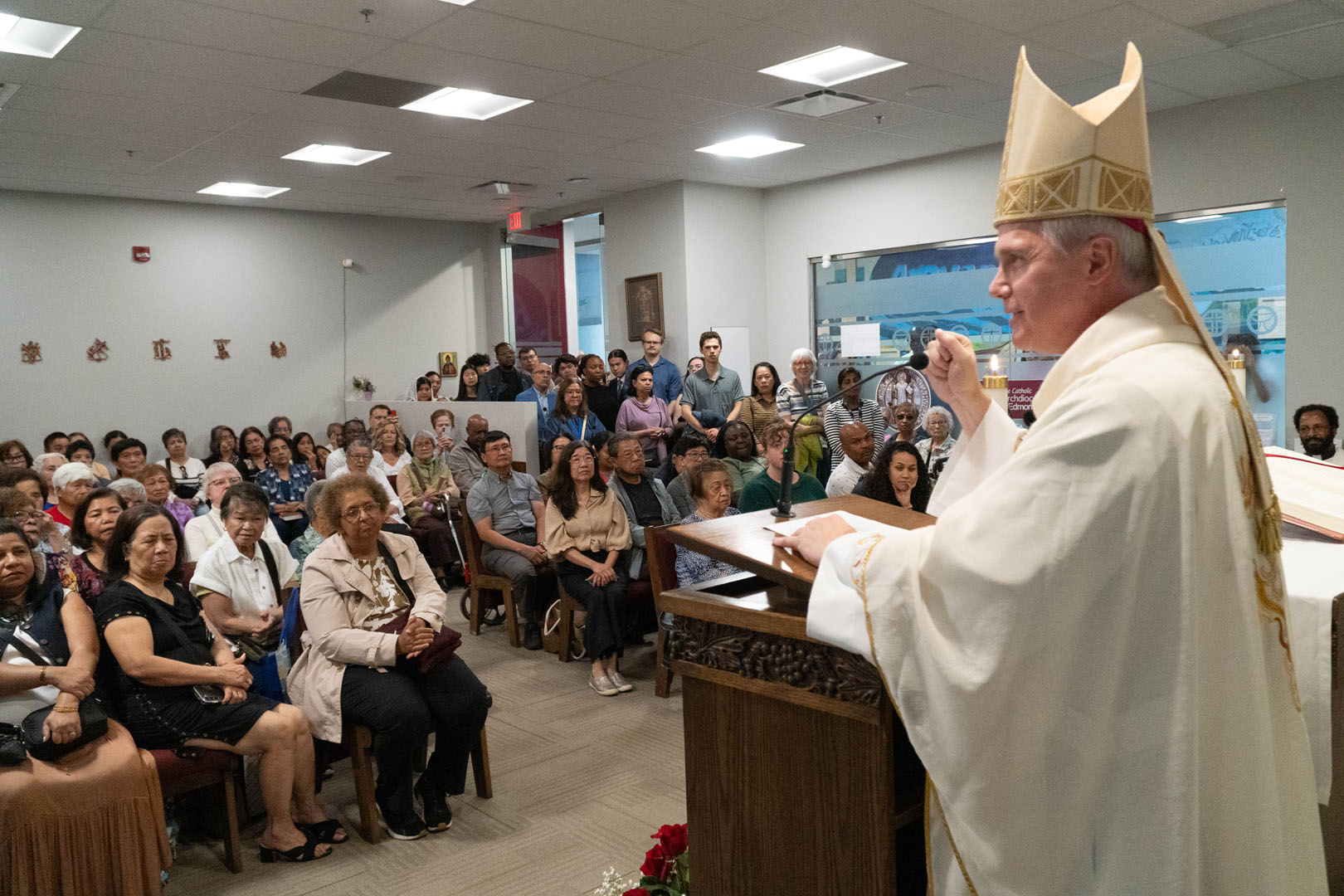
Saint Benedict’s chapel here at City Centre Mall has certainly been a place and as space for God’s people to gather and be built up in our evangelizing, praying, and reconciling mission amid the daily demands of our work. I am grateful to the vision of my predecessor Cardinal Collins who wanted to put a chapel in the midst of a once bustling place of work and business in downtown Edmonton. I know many people have cherished this sacred space close to their place of work and will have to go farther to find oases of prayer in nearby parishes. I wish to sincerely thank Father Tesfu Kelati and all the priests who have served this community through the last twenty years and for all who have attended celebrations here.
Ezekiel has a vision of a purified temple and can see its destruction and rebuilding in the future. As Christians, we believe that the Lord Jesus is really the new Temple raised up by God in three days. Every church building or chapel is a sign of the more permanent reality of God’s Church as the Body of Christ. The people marked by the mystery and faith in his saving Cross are living stones in that temple and bring Christ’s worship and life wherever we go in our workplaces and families.
We are thankful for numerous parishes in the downtown area where people may find places for quiet, prayer, and the celebration of the sacraments. I invite each one of us to be conscious always of the dignity of the cross that marks our life, our dyings and risings in Jesus Christ, the evangelizing mission of reconciliation that, though each of us, is building up Christ’s temple in our world.
✠ Most Rev. Stephen A. Hero
Archbishop of Edmonton
St. Benedict Chapel, Edmonton
August 12, 2026
Sign up for The WINDOW, the weekly electronic bulletin with news from the Archdiocese of Edmonton.