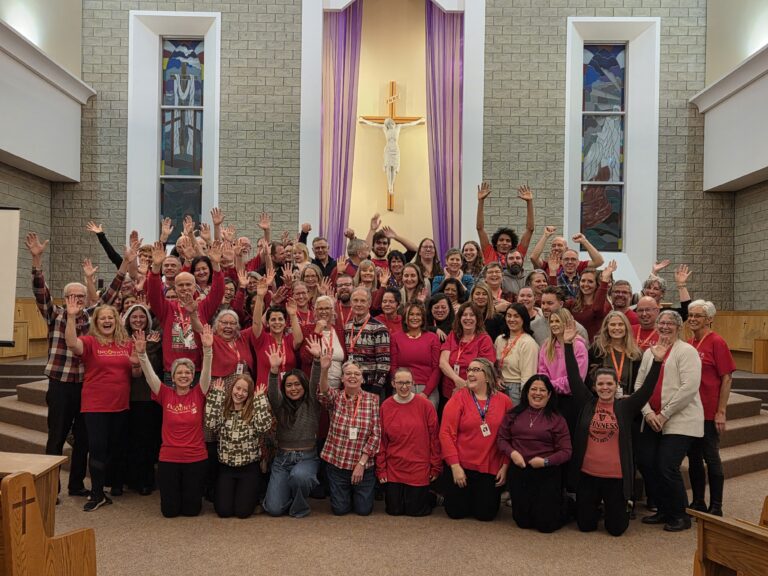
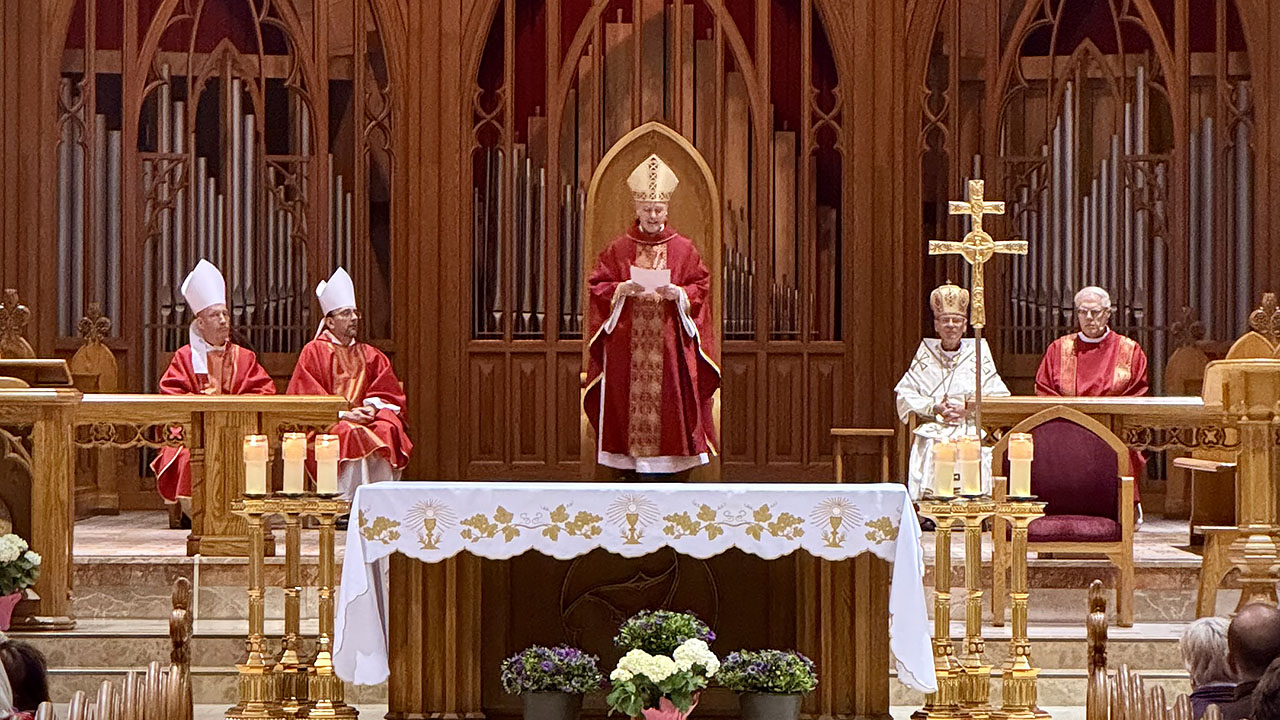
Fire and blood. We wear red vestments today in honour of the apostle Matthias.
Fire and blood. Those words may evoke violent images for us: fire can destroy, blood can be shed. But they are also the stuff of life.
In the Scriptures blood is sacred and symbolizes life. Shedding human blood is thus a terrible crime. The blood of the murdered Abel cries out to God from the ground. Fire also represents life. It brings light, provides heat and protection from wild animals. The discovery of how to make fire is the beginning of human survival and culture.
We wear the colour of fire and blood on the feasts of apostles like Matthias to represent the flame and inspiration of the Holy Spirit, their burning love of God, and their faithful witness to Christ in the face of persecution and often a brutal death that mirrors Christ’s own Cross.
As we celebrate this Mass for Life today, it is moving and evocative to do so robed in red.
I wonder what Matthias is thinking when he is suddenly elected by the remaining eleven apostles who seek to replace the apostate Judas. Judas’ robes were red for other reasons. It was Jesus’ blood on them and the blood of Judas too who added his own when he couldn’t cope with his betrayal of his Friend and Lord.
Taking the place of Judas. It couldn’t have been a comfortable call for Matthias. Did the other fellow Joseph Barsabbas breathe a sigh of relief? “It was not I, Lord.”
The call, the election, of Matthias, is truly a call to fire and blood, a walk and a march for life. Imagine his grief at the loss of their friend Judas and Judas’ desperate suicide. When discerning which man should be proposed as a successor to Judas as the twelfth apostle, the Eleven look for those who “accompanied [them] during all the time that the Lord Jesus went in and out among [them], from the baptism of John until the day when [Jesus] was taken up from [them] because the future apostle “must become a witness with [them] to [Jesus’] resurrection.”
So their great qualification is someone who knew Jesus in the flesh and saw his resurrection in the flesh. Matthias and the other apostles are witnesses to life, the human life that Jesus came to embrace for us as a man, the life he came to heal, to bring to a greater dignity than it ever had, the life that has its glorious purpose and destiny in union with God.
Judas – for whatever reason – sought to cancel or end the life and love that Jesus brought into our flesh and our world. He ended up by destroying his own life too. Cancelling innocent human life ends in suicide.
Matthias, putting on this apostles’ mantle red with blood, does so with the gift of the Holy Spirit. Although the apostles did some discernment about who should replace the twelfth apostle, they left the actual choice to the Holy Spirit. It is God who calls Matthias to be an apostle of life and an official witness of the resurrection of Jesus.
If Matthias had concerns about his own worthiness or ability to meet the challenge, we do not know. But he was already a witness of all that God had done in his Son Jesus and he had lived with and followed the Lord with the others from the beginning. He had heard Jesus call him “Friend,” not “Servant,” and saw Jesus pouring out his life and love for the world in the Eucharist and on the Cross.
Jesus’ resurrection, conquering sin and death, is the triumph of love and mercy. Human life is always loveable and good. It cannot be discarded or thrown away. It is meant for eternal life and resurrected life, body and soul. Jesus became a man and died to save what we were willing to kill or cancel. He became fragile and endured the pains and sufferings that we do, to show us that he is one with us in the darkness, a Friend and Companion who walks with us and marches bravely even into the jaws of death to call us back to life.
Matthias, and the other apostles, knew the power of the resurrection that Paul proclaims to the Ephesians as the reason for our hope and the “glorious inheritance we have among the saints.” Paul describes the power of God raising Jesus from the dead, seating him “at his right hand in the heavenly places, far above all rule and authority, power and dominion, and above every name that is named. […] And [God] has put all things under [Jesus’] feet and has made him the head over all things for the Church, which is his body, the fulness of him who fills all in all.”
It is this vision of the dignity of God’s gift of life and God’s complete sovereignty over life as its Sustainer and dearest Friend that gives life and courage to Matthias today. Matthias says ‘Yes’ to his mission to replace Judas and to become an apostle and witness of life to people around him.
It is this hopeful vision that impels us too as followers of Christ to lovingly befriend every human face and to become the defenders, protectors, advocates of those most in need.
Our world knows many ways that human life is threatened and human dignity is being dismissed or discarded: the effects of poverty, family violence, the scourges of war, willful murder, abortion, euthanasia, human trafficking, prostitution, pornography, drug abuse and addiction, lack of suitable care for the elderly and disabled, and the mentally ill.
How can we walk with our brothers and sisters who are suffering, threatened, or in need to bring light and hope to their life? How can we march with them as eloquent and passionate advocates to ensure that their rights, dignity, and life is not forgotten or belittled?
Pope Leo said very powerfully at the beginning of this year that “the protection of the right to life constitutes the indispensable foundation of every other human right. A society is healthy and truly progresses only when it safeguards the sanctity of human life and works actively to promote it.” (Address of Pope Leo to Members of the Diplomatic Corps January 9, 2026)
Dear brothers and sisters, on this Feast of St. Matthias, we are reminded of our call to be an apostle of the life that Jesus offers to the world. We ask the Lord to bless our hopes and efforts today and every day to befriend and concretely assist those in need and to safeguard their life and dignity. We walk to accompany. We march to witness.
May our Blessed Mother surround us with her mantle of prayer. Today it is a red mantle like that of Matthias. Red for fire, red for blood. May the fire and light of the Holy Spirit help us to lovingly and patiently build a culture of life and peace. There is blood on our hands in our beloved Canada. “Blessed is the one with clean hands and a pure heart!” (Ps 21:4) With clean hands and a pure heart, may we work for a society that does not shed blood but which upholds the dignity and sacredness of every human life.
✠ Most Rev. Stephen A. Hero
Archbishop of Edmonton
St. Joseph’s Cathedral Basilica, Edmonton
May 14, 2026
Read more about the Hope and Dignity pastoral initiative
Sign up for The WINDOW, the weekly electronic bulletin with news from the Archdiocese of Edmonton.